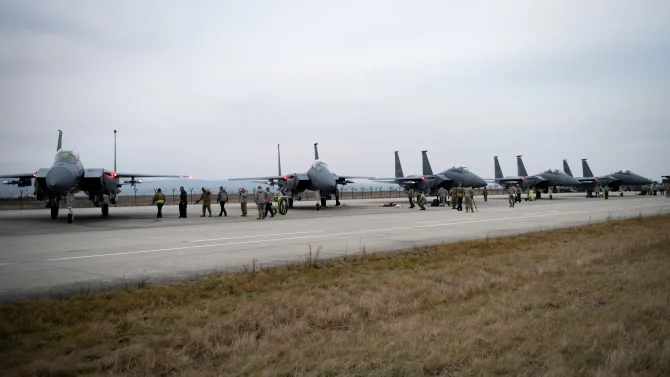

American F-15 planes stationed in Câmpia Turzii.
Photo source: U.S. Air Force
The communes of Mihail Kogălniceanu and Deveselu, and the town of Câmpia Turzii are some of the best examples of communities that have become more urbanised under the positive influence of the local military facilities. Cătălin Podaru, the founder and director of Leviatan Design, one of Romania’s military contractors, explained for the readers of DefenseRomania why these military facilities are more than just a security factor.
“Leviatan Design” is involved inter alia in very large military infrastructure projects, including the one in Sibiu, inside the South-East Multinational Corps Command, but also in operational infrastructure projects that are implemented in “General Emanoil Ionescu” Air Base 71 (Câmpia Turzii).
Such works at Sibiu, as well as at Mihail Kogălniceanu 57th Air Base, “General Emanoil Ionescu” Air Base 71 from Câmpia Turzii or Deveselu Air Base are more than just military facilities.
Cătălin Podaru explained that “a very important aspect about investing in military infrastructure is that these military bases are not located in highly urbanized areas.”
“Everything that is related to military operations is developed within the facility, but the administrative area around that base develops too,” explained the director of “Leviatan Design”, in an interview with DefenseRomania about military infrastructure projects.
“A lot of troops and equipment are stationed in Romania and on the Eastern Flank, while other incoming military need to get familiar with the area and settle in before moving away as part of their rotation cycles.
These features are very important, this is about the amenities that should be available in the military facilities and that should match the standards expected by any NATO troops wherever they operate; but in addition to these standards, some other accommodation facilities need to exist near the bases, maybe similar to those mini-neighbourhoods they have in Germany ”, said the CEO of Leviatan Design.
Romanian communities that are home to allied troops get rapidly urbanised nearing the standards available in US or Western Europe.
Basically, we are talking about a genuine urban infrastructure which is available inside the bases: you will see schools, kindergartens, even hospitals. Moreover, urban development take huge leaps inside those communes that host these military bases.
And this leap is both qualitative and quantitative. Allied soldiers who are deployed from Ramstein Air Force Base (Germany) or other military facilities in Europe find in Romania the same training conditions and standards they have in their own home bases.
“You will find mini-cities that serve the bases in many ways, including high-quality residential buildings”, added Cătălin Podaru, who mentioned “the need to provide schools, kindergartens, medical care or ancillary services”.
Most soldiers who are deployed to Romania bring their families. Since they need to stay focused on their missions, they must know that their families enjoy high-level conditions “, Podaru explained.
Mr. Podaru also explained that this sort of development brings economic benefits in the less urbanized areas that are home to deployed troops who – alongside the locals – can enjoy the same sort of urban amenities that are available in US and Europe.
“Military bases bring great development opportunities in the communities hosting them that can skip in this way some of the intermediate stages of the urbanization process”, concluded Cătălin Podaru.