

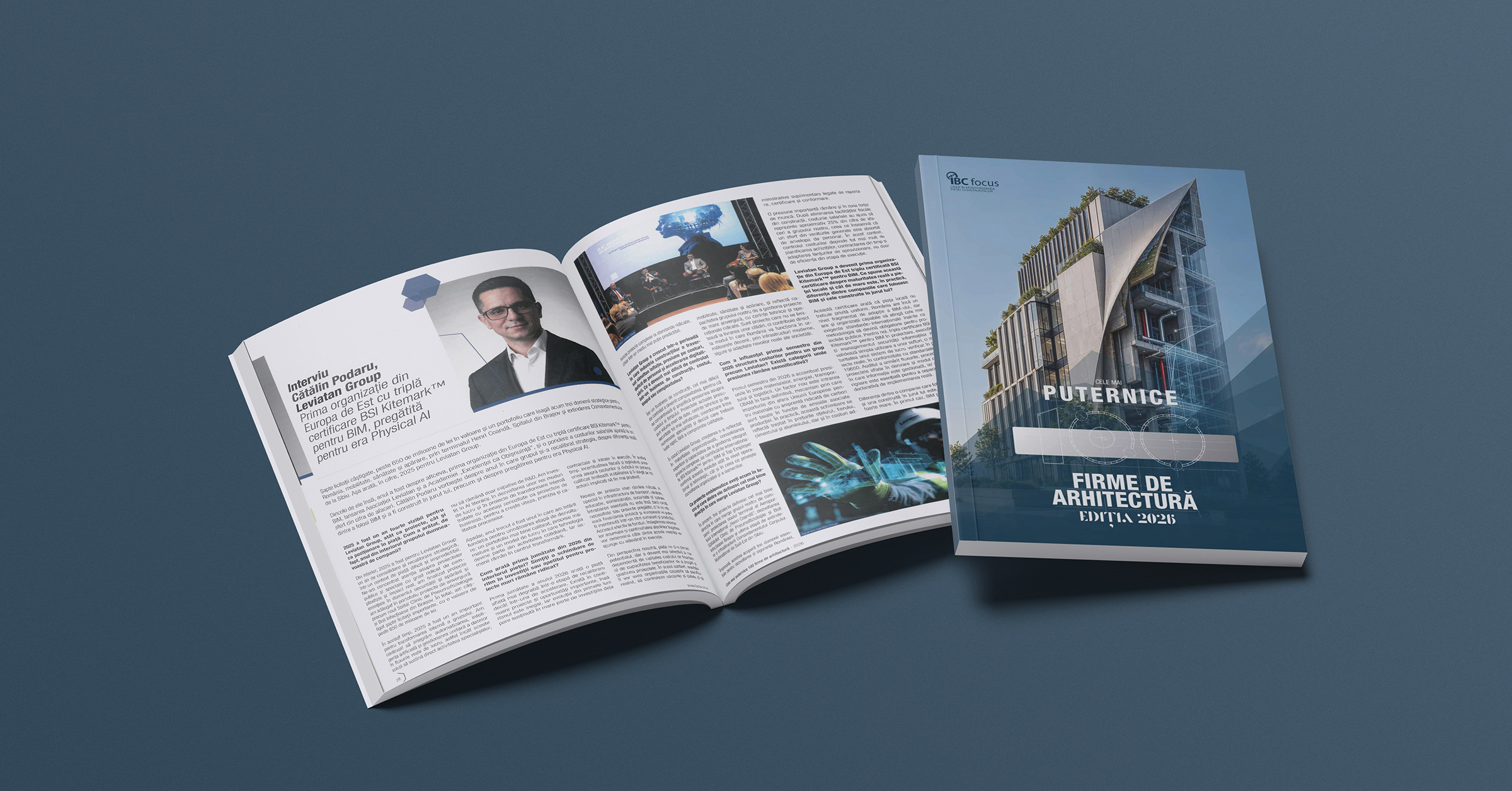

Leviatan Design ranks 3rd in the 2026 edition of the TOP 100 Most Powerful Architecture Firms in Romania, compiled by IBC Focus, marking its fifth consecutive year in the top three. In the same edition, Cătălin Podaru, Founder and CEO of Leviatan Group, discusses the group’s consolidation, strategic recalibration, and the internal transformations underpinning the next stage of development.
In a difficult and unpredictable market, the group has focused on public and special projects with a high degree of complexity and real impact. Cătălin Podaru also analyses how the market evolved in the first half of 2026, from the uneven pace of investment and cost pressures to the importance of continuity in public and European funding. In the interview, he discusses the completion of key projects in the security and defense sector and the expansion of the portfolio with large-scale investments such as the new Clinical Hospital of Pneumophthisiology and Infectious Diseases in Brașov. Growth is also viewed in terms of organizational maturity, consolidated expertise and the capacity to manage complex projects in an integrated way.

Another important topic is the transformation of the way of working: integrating automation, artificial intelligence, and unified data management into specialists’ work. Cătălin Podaru talks about the BSI Kitemark™ for BIM certification obtained by Leviatan Design and Ubitech Construcții, the investments in people and education, and the development of AI skills to increase the speed, accuracy and quality of processes. The discussion also covers the differences between generations of engineers, as well as the role of digitalization, which is becoming an essential condition for the future of construction companies.
The interview also brings to the fore the challenge of managing complexity in construction, from large volumes of data and technical and security requirements to coordinating disciplines and making decisions quickly. It highlights the indicators of a company’s health beyond turnover: delivery predictability, financial discipline and team collaboration. With a better-calibrated portfolio and more mature processes, the group is preparing for further development and for the transition to the Physical AI era, keeping people at the center of the transformation.
Below is an excerpt from an interview with Cătălin Podaru, published by IBC Focus in the 2026 edition of the TOP 100 Most Powerful Architecture Firms magazine.
What does the first half of 2026 look like from inside the market? Do you sense a change of pace in investment, or does the appetite for large projects remain high?
The first half of 2026 shows a market that is in a phase of recalibration rather than acceleration. Significant projects and opportunities remain, but the pace is uneven, and the performance of the first few months appears to be driven largely by investments already contracted and under construction. At the same time, fiscal and legislative uncertainty, cost pressures, and a shortage of skilled personnel limit visibility and force everyone involved to be more cautious.
The need for large projects remains high, particularly in transport infrastructure, healthcare, education, public administration, security and defense. The key question, however, is not whether the need exists or whether projects are ready, but to what extent public and European funding can be maintained at a steady and predictable pace. Actual access to funds, delivery of the reforms committed to and continuity of budget allocations will determine how many of these investments truly reach the construction stage.
From our perspective, the market has not lost its potential. Still, it has become more selective and more dependent on the quality of the funding framework and on clients’ capacity to prepare and manage projects. In this context, the advantage will lie with organizations that can plan realistically, control costs and data, and deliver complex projects to high standards, even in a less predictable environment.
Is there a difference between the new generations of engineers and those who built the industry over the past 20–30 years?
There is a major difference between the new generations of engineers and those who built the industry over the past 20–30 years, because the profession itself has changed radically. Previous generations built the industry through experience, rigor and technical competence. In contrast, today’s professionals, supported by BIM, automation and artificial intelligence, can do far more in far less time and can manage an incomparably higher level of complexity. At Leviatan Group, this paradigm shift better defines the way we work and emphasizes the role of creator that each of our specialists has, as a result of integrating artificial intelligence into our workflows.
Is there a point at which digitalization stops being a competitive advantage and becomes a minimum condition for survival?
Yes, and in construction that point is already very close. As projects become more complex, deadlines tighter and costs harder to control, and as the shortage of specialists deepens, companies that do not integrate their data, processes and decisions into digital systems will quickly lose speed, quality and predictability. Digitalization remains an advantage only for those who adopt it ahead of the market; once BIM, automation, and artificial intelligence become the standard way of working, their absence becomes an existential risk. The difference will no longer be between traditional companies and technology-driven companies, but between organizations able to manage complexity and those that can no longer keep up.
Construction companies are almost always assessed by turnover and portfolio size. Which indicators does the market ignore, even though they say far more about a company’s real health?
Turnover and portfolio size remain important benchmarks, but they offer only a partial picture of a company’s health. Equally relevant are delivery predictability, the ability to control costs and deadlines, information quality, financial discipline, and the strength of relationships with partners and subcontractors. In an increasingly complex market, it also matters how well an organization aligns design, construction and operation, so risks are anticipated and investments retain their value after handover.
Increasingly important, too, are indicators of internal maturity: the ability of teams to collaborate, the speed and clarity of decisions, investment in technology and in people’s development, and how these resources are integrated into day-to-day work. From this perspective, a healthy company is defined not only by the volume it manages, but also by its ability to grow sustainably, keep complexity under control, and deliver consistently at a high level of quality.
Interview published in the 2026 edition of TOP 100 Most Powerful Architecture Firms magazine, printed by IBC Focus.