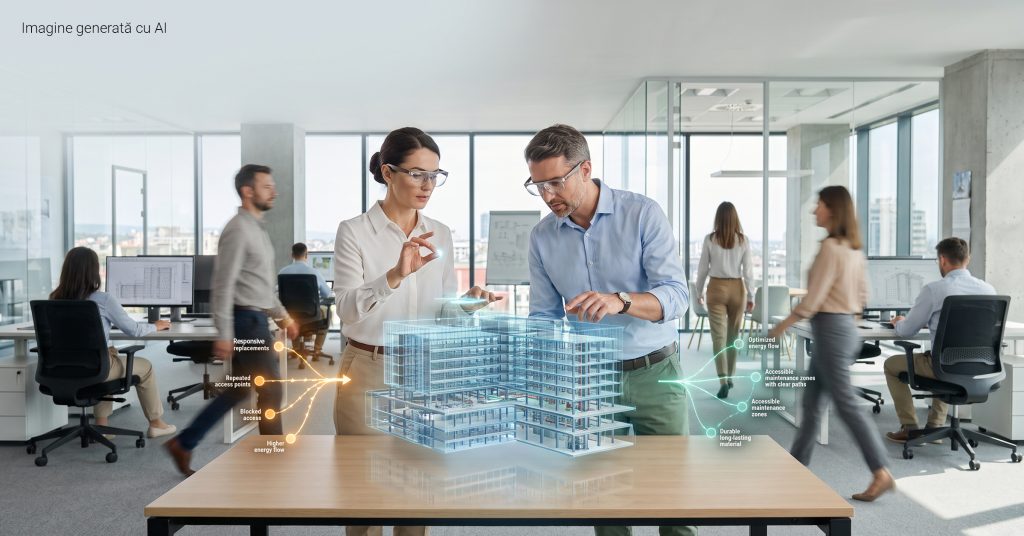
Voce generată cu AI.
The 2024 trends in architecture reflect a powerful convergence of sustainability, technological innovation, and adaptable design, according to an article published by CADdetailsBlog.
As with previous years, the architecture industry continues to place a strong emphasis on sustainability—but in 2024, the approach is clearer, more structured, and more effective, as reported by Dezeen. This shift brings zero-emission buildings, smart structures that enhance energy efficiency and user comfort, and spaces that prioritise well-being to the forefront of architectural priorities.

These developments highlight a deeper commitment to environmental responsibility, integrating cutting-edge technologies to optimise resources and minimise ecological impact. Sustainable design, in the context of accelerating climate change, is no longer optional—it has become a strategic necessity, as emphasised in a recent Gensler article.
There is also growing momentum around modular construction and repurposing existing spaces, pointing to a more flexible and sustainable approach to urban development. Meanwhile, inclusivity and accessibility are becoming essential pillars in architectural design, with an increased focus on universal design that reflects the diverse needs of today’s communities.
The rising popularity of modular architecture lies in its ability to deliver adaptability, speed, and cost-efficiency. This design method significantly reduces construction time, waste, and overall project costs.
Technological integration is also reshaping the architectural landscape. The use of virtual reality (VR) and augmented reality (AR) is opening up new dimensions in spatial design, allowing professionals to better visualise and refine projects. At the same time, artificial intelligence (AI) is evolving beyond process automation, offering major benefits throughout the project lifecycle.

As highlighted by Disruptr MY, AI improves the design process through predictive analytics, enhances decision-making, and integrates seamlessly with BIM (Building Information Modeling)—transforming how architects tackle complex challenges and optimise outcomes.
The future of architecture lies in the convergence of multiple technologies. AR and VR are enriching collaboration within BIM workflows, while Digital Twin technologies are advancing rapidly, enabling real-time access to project data and performance analytics. Together, these tools are redefining standards of efficiency, precision, and profitability.
The trends of 2024 signal a definitive shift toward more resilient and responsive built environments, designed with social and environmental responsibility at their core.
Through the early adoption of sustainable thinking, the consistent use of the BIM methodology, and the integration of advanced technologies, Leviatan Design is perfectly aligned with the future of architecture as outlined in the industry’s 2024 outlook.
Every project undertaken by Leviatan Design reflects its commitment to balancing innovation with environmental stewardship. More than just keeping pace with market demands, the company is actively shaping the future of architecture in Romania through sustainable, forward-thinking projects.